
Randolph County Arrest Records and Court Charges
Arrest records document the law-enforcement side of an event: the arrest, incident or booking information, custody status, and the agency involved. In Randolph County, sheriff and police records are separate from the Circuit Court file. Missouri law treats law-enforcement incident and arrest reports as open records subject to statutory limits, but that does not make every investigation note, juvenile matter, or sealed item public.
Court charge records begin after review by the prosecuting attorney. The Randolph County Circuit Clerk files criminal cases from traffic violations to felonies, and filed charges become part of the court case. A single arrest may produce several charges, a different charge than the arrest label, or no charge filed in court. For current custody and jail roster information, use Randolph County inmate records. For the complete criminal case file, use the criminal court record rather than the arrest entry alone.
The first manifest image for this page is sourced from RSMo 610.100, the Missouri statute addressing law-enforcement incident and arrest records.
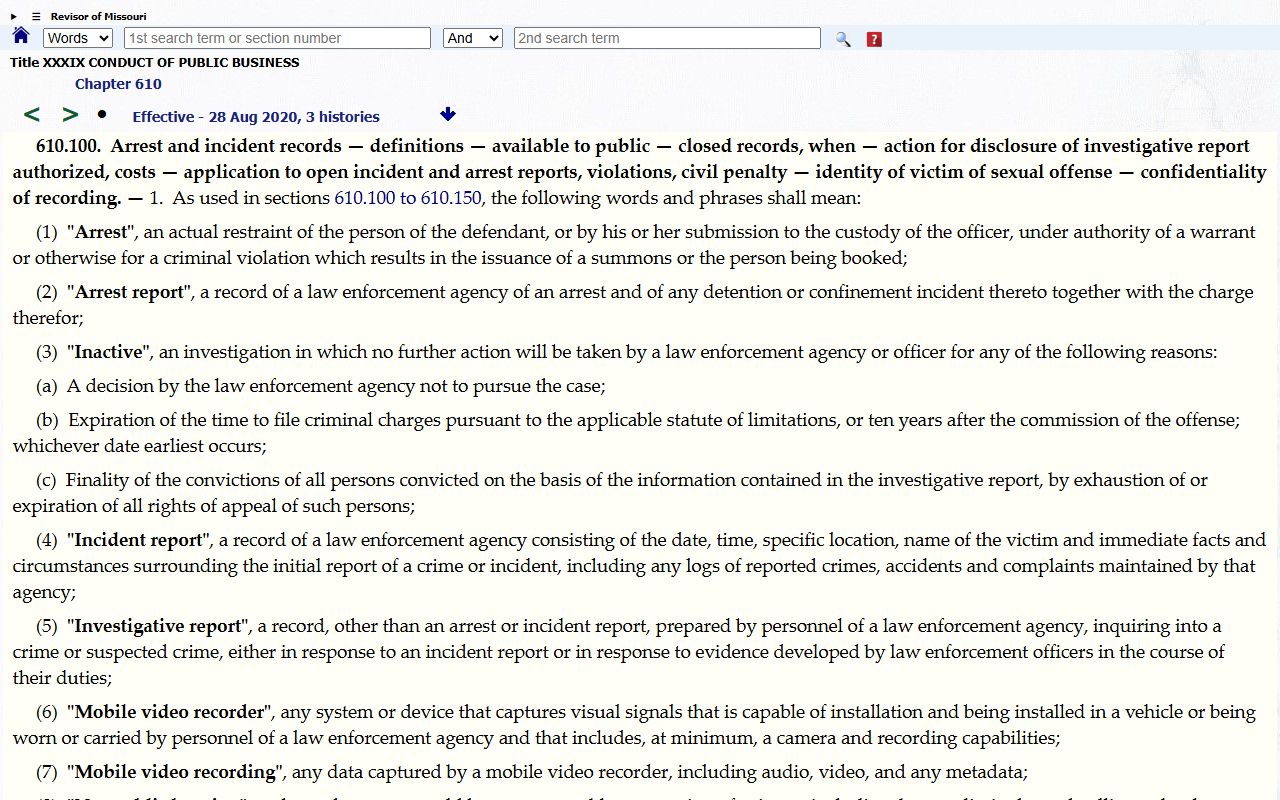
This statute source supports the difference between law-enforcement arrest records and the court charge records filed after prosecutor review.
How to Find Randolph County Arrest Records and Charges
Use the record channel that matches the fact needed. For a jail booking or current custody question, start with the Randolph County Sheriff's Office inmate roster or direct sheriff contact. For filed criminal charges, use Missouri Case.net and the Randolph County Circuit Clerk. For a prosecution contact question, the county Prosecuting Attorney page names Stephanie Luntsford and lists the county office phone as (844) 277-6555 ext. 600, with hours Monday through Friday 8:00 a.m. to 4:00 p.m.
- Search Case.net by case number or litigant name for a filed Randolph County criminal, traffic, or municipal case.
- Select the correct court location or Randolph County case when multiple matches appear.
- Open the case and read charge entries, docket events, bond entries, hearing dates, pleas, and dispositions.
- Contact the Circuit Clerk at 372 Hwy JJ, Suite 1A, Huntsville, MO 65259 for certified copies, older files, or access questions.
Case.net may show case number, court division, parties, attorneys, docket entries, scheduled hearings, judgments, dispositions, charges, fines, costs, and document links where remote public access is allowed. Public documents expanded remotely beginning July 1, 2023, but confidential, sealed, juvenile, expunged, and protected materials remain limited.
If a public search does not show the expected charge, check the stage of the case before assuming the record does not exist. A new arrest may still be with law enforcement or the prosecuting attorney, an older case may require clerk help, and a restricted case may show little or nothing online. The Circuit Clerk is the court-record contact, while sheriff or police agencies remain the custodians for arrest and incident reports.
How Charges Get Filed After an Arrest
Police or sheriff deputies may make an arrest or submit a probable-cause referral, but the prosecutor decides what to file in court. Missouri uses the term Prosecuting Attorney at the county level. Once the prosecutor files a complaint, information, indictment, or other charging document, the Circuit Clerk opens or updates the public court case when the matter is eligible for public display.
| Record | Primary Source | What It Means |
|---|---|---|
| Arrest or incident report | Sheriff or police agency | Law-enforcement record of an arrest or reported event, subject to Missouri public-record limits. |
| Booking record | Sheriff or jail | Custody record that may show current holding status, bond, charge labels, or holds. |
| Information or complaint | Prosecuting Attorney | Formal charge filed in court after review. |
| Criminal case docket | Circuit Court and Circuit Clerk | Public court event history, hearings, pleas, dispositions, costs, and sentence entries when public. |
Charge Status and What It Means
Filed charges can change during a case. A pending charge is unresolved. A charge may be amended or reduced by prosecutor action or court order. A charge may be dismissed with prejudice or without prejudice. A disposition records the result, such as conviction, dismissal, acquittal, plea, sentence, or other final outcome shown in the court file.
| Status | What It Means |
|---|---|
| Pending | The charge has been filed and remains unresolved. |
| Amended or reduced | The filed allegation changed, often by severity, statute, or wording. |
| Dismissed | The charge was ended by the court or prosecutor; dismissal language matters for future effect. |
| Disposition entered | The court record reflects the final result for the charge or case. |
Charges vs. Convictions
A charge is an accusation filed in court. A conviction is a finding or plea that establishes guilt. Public searches can show both, and the difference is critical for employment, housing, licensing, immigration, and personal-record review. A person can have an arrest without a filed charge, a filed charge without conviction, or multiple charges with different outcomes in the same case.
| Charge | Conviction | |
|---|---|---|
| Stage | Accusation filed by the prosecutor | Verdict, plea, or finding entered by the court |
| Proof level | Begins from probable cause or charging review | Requires proof beyond a reasonable doubt or a valid plea |
| Public record | Often public unless restricted | Often public unless sealed, expunged, juvenile, or otherwise confidential |
Sealed vs. Expunged Records
Missouri expungement is governed by RSMo 610.140 for qualifying criminal records. Once expunged, court and administrative records become confidential except as allowed by law. Expungement is not the same as destroying every trace for all purposes; some agencies, employers, licensing bodies, law-enforcement uses, or statutory exceptions may still require disclosure or allow access.
The second manifest image is sourced from RSMo 610.140, Missouri's criminal record expungement statute.
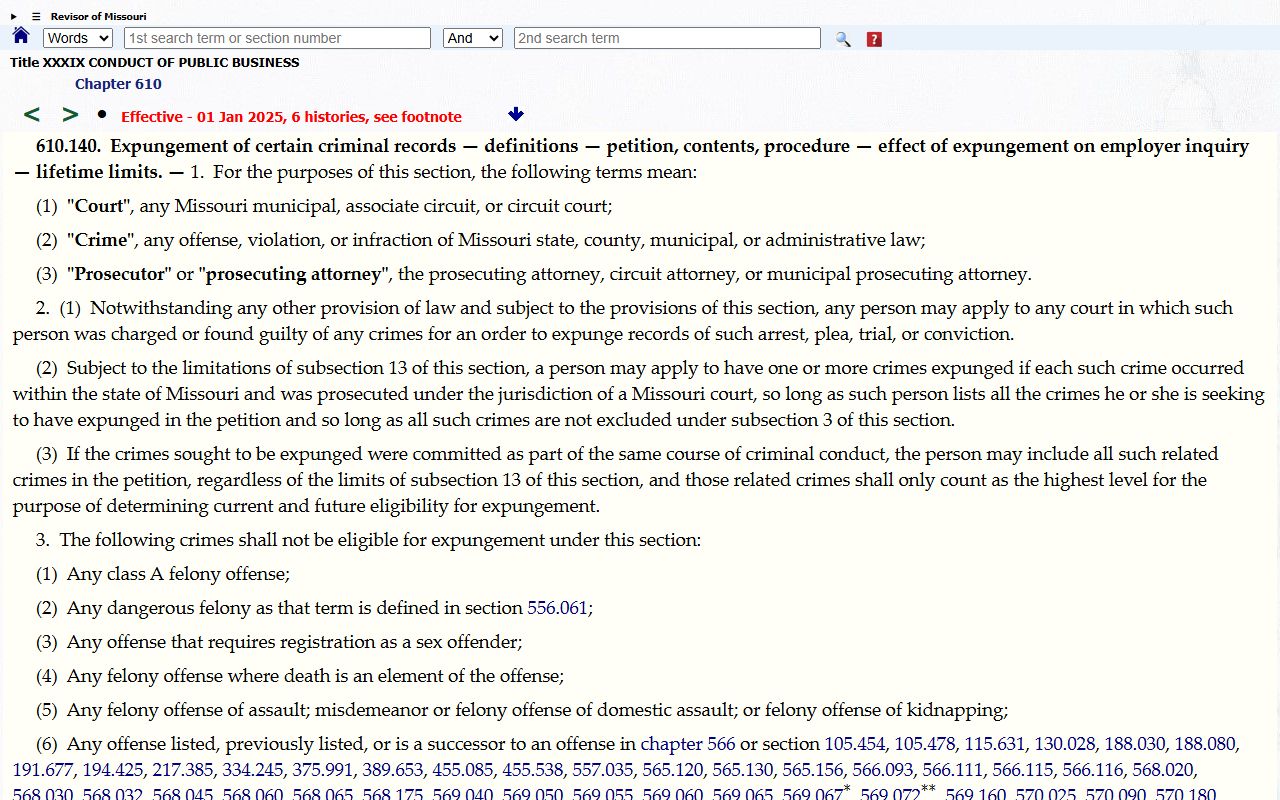
The expungement statute matters because a public search can miss records that were legally closed after a court order.
| Sealed | Expunged | |
|---|---|---|
| Public visibility | Limited by court order or statute | Closed to the public after a qualifying order |
| Access | May require party status, court order, or statutory authority | Available only as permitted by law after expungement |
| Local action | Ask the Circuit Clerk what order controls access | File in the court with jurisdiction over the offense, violation, or infraction |
Charge Codes and Severity Levels
Court charge records can include a statute or ordinance citation, a charge description, and a severity level such as felony, misdemeanor, infraction, or municipal ordinance violation. One arrest can generate multiple charges, and each charge may have its own disposition. Traffic violations can also be criminal cases in the Circuit Court record because the Circuit Clerk's official duty list covers criminal cases from traffic violations to felonies.
Missouri Courts publishes a case-type list with categories and codes across civil, criminal, domestic, probate, juvenile, small claims, traffic, and municipal matters. The code helps identify the type of case, but users should read the full docket and disposition rather than relying on a short label.
Charge severity can also affect which public offices are involved. A felony or misdemeanor filed in the Randolph County Circuit Court will be tracked through the court case, while a city ordinance charge may have a municipal division path. A warrant entry, bond order, or failure-to-appear note can appear beside the charge, but those entries should be verified with the issuing court or sheriff before anyone treats them as current.
State and Federal Charge Context
Randolph County charges filed by the local prosecuting attorney are Missouri state court matters. Federal charges are separate and route through the U.S. District Court for the Western District of Missouri, PACER, CM/ECF, and the U.S. Attorney for the Western District of Missouri. A federal prosecution will not be fully searched through Randolph County Case.net records.
The third manifest image for this page is sourced from the U.S. Attorney for the Western District of Missouri.
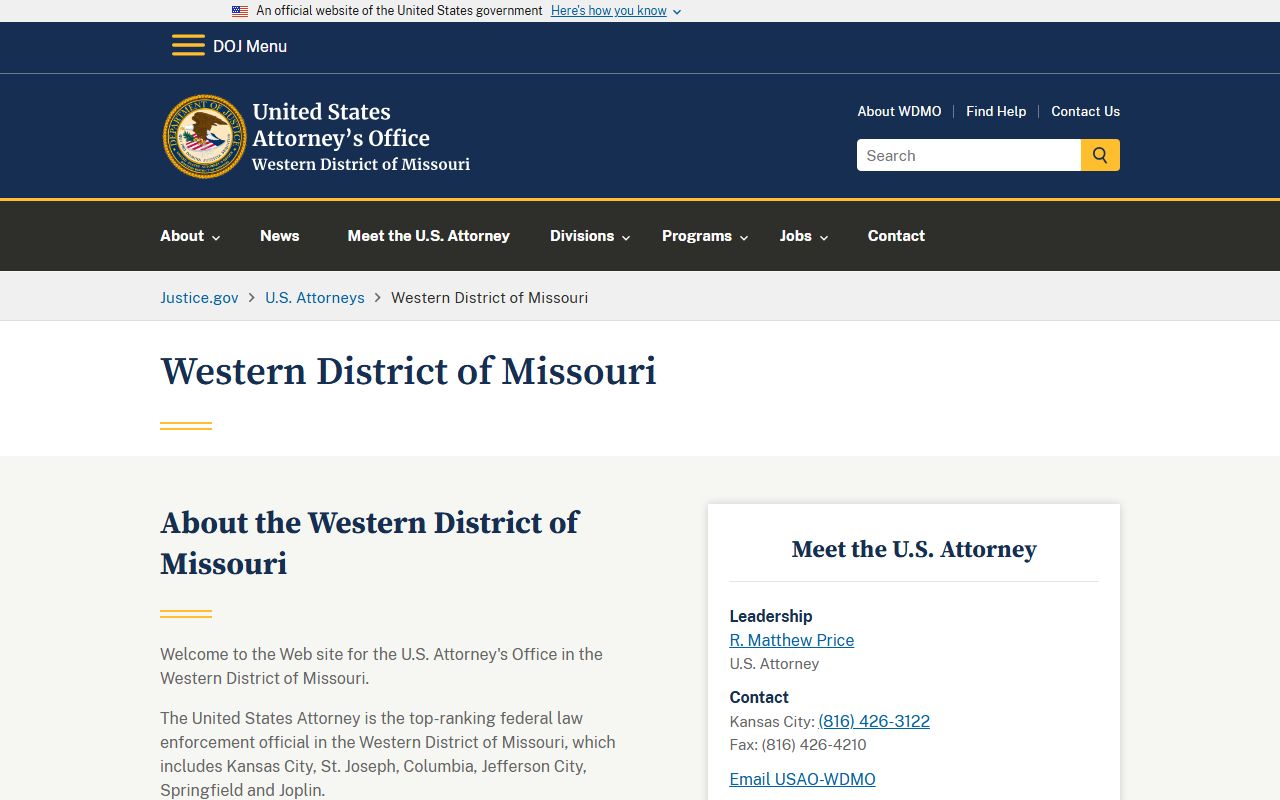
This federal source helps distinguish county prosecution from federal criminal cases that use different courts and different record systems.
Background Check Considerations
Casual court lookups are not the same as regulated employment, tenant, credit, insurance, or licensing background checks. Court records can be incomplete, delayed, restricted, or misunderstood if the searcher reads only a charge label without the disposition. Anyone using records for a regulated decision should follow the Fair Credit Reporting Act and any applicable Missouri or federal requirements.
Important: Randolph County Court Records is not a consumer reporting agency and cannot be used for FCRA-regulated screening decisions.
Restricted Charge Records in Randolph County
Juvenile court records are confidential under RSMo 211.321 subject to exceptions. Adoption records, many mental health matters, sealed records, expunged records, protected addresses, minor children's identifying information, and victim-sensitive information may be restricted or redacted. Prosecutor review materials and active investigation files may also be limited even if a basic arrest or court entry is public.